Before You Say Yes: A No-Nonsense Checklist for Vetting a Skip Quote
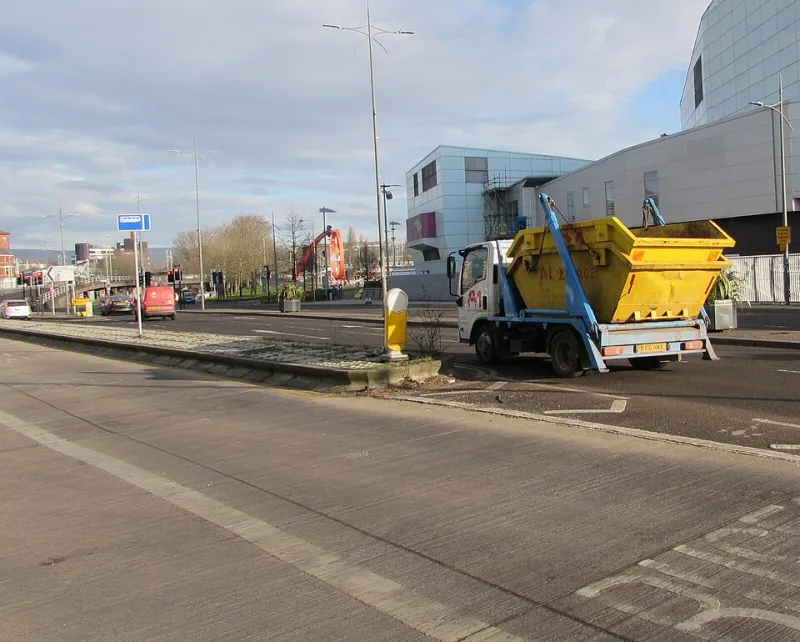
Photo: Jaggery , CC BY-SA 2.0, via Wikimedia Commons
A skip quote is a conversation, not a contract. That distinction matters more than most people realise, because the number you hear down the phone is usually a best guess dressed up as a price. The firm is quoting for a certain size of skip, at a certain address, for a certain number of days, holding a certain weight of rubbish. Change any one of those and the invoice changes with it.
None of that is underhand. It's simply that nobody volunteers the conditions unless you ask. So ask. Below is the list we'd run through ourselves before handing over a card number.
Start with size, then immediately ask what it weighs
Most people open with "what size skip do I need?" and stop there. The follow-up that actually protects you is the tonnage question. A six-yard skip gives you six cubic yards of space, but the weight allowance might be one tonne, or it might be two, and that gap is the difference between a clean job and a surcharge.
Ask: "What's the included weight on that size, and what do you charge per tonne after that?"
Heavy materials — soil, rubble, tiles, concrete — hit the weight ceiling long before the skip looks full. Light bulky stuff — timber, cardboard, old kitchen units — does the opposite. Knowing which problem you have tells you whether you're buying space or buying allowance.
Pin down how overage is calculated
"Per tonne over" sounds straightforward until you discover it's charged per part-tonne, or that there's a minimum overage fee, or that the weighbridge ticket carries an admin charge on top. Get the mechanic in plain words: per tonne or part-tonne, what the rate is, and whether anyone will ring you before the load is tipped so you can decide.
Ask whether the permit is inside that number
If the skip is going on the road, verge or pavement, a council permit is non-negotiable. Firms handle this three different ways: the fee is included, the fee is passed through at cost, or the fee comes with a handling charge bolted on. Ask which one you're getting, who fills in the application, how many working days it takes, and what happens if the council says no or attaches conditions.
Establish what "the hire" actually means
Standard hire periods vary — seven days here, fourteen there. Ask how long is included, what an extra day costs, and whether the permit window matches the hire window. A fourteen-day hire sitting under a seven-day permit is a classic source of avoidable cost.
Get a figure for wait-and-load
If your road is busy, narrow, or has no legal place to park a skip, the driver may have to sit with the vehicle while you fill it. That's a timed charge, usually by the half hour. Ask for the rate up front rather than discovering it on the day.
Confirm where the driver can legally put it
Describe your access honestly: dropped kerb or not, double yellows, overhanging branches, a lane too tight for a seven-and-a-half-tonner, a gate you can't open. Drivers can and do refuse a placement, and a refused delivery can still attract a charge. Better to have that conversation now.
Read out what you're planning to bin
Plasterboard, mattresses, tyres, fridges and freezers, paint tins, gas bottles, batteries, asbestos, food waste — every firm has a list of things that either can't go in or need their own arrangement. Ask specifically about anything unusual in your load, and ask what happens if a banned item turns up mixed in.
Check the VAT position
Is the number you've been given inclusive or exclusive? It sounds trivial until a £280 quote becomes £336 at invoice stage. Ask them to confirm in writing.
Nail down the delivery window
Morning or afternoon, first-drop or last-drop, and how much notice they need. Same-day or next-day usually carries a premium, and booking three to five days ahead is almost always cheaper than an emergency hire.
Ask about a second skip before you need one
On a renovation, one skip rarely finishes the job. Ask what a swap costs, whether a second skip on the same job gets a better rate, and whether the same permit covers the replacement.
The warning signs
A quote that names no size, no tonnage, no permit line and no hire period isn't a quote — it's a number. Add pressure to book on the spot, a request for cash only, or an unwillingness to give a waste carrier registration number, and you should walk away. The registration is checkable on the public register in about two minutes, and any legitimate operator will hand it over without a flicker.
Then ask for it by email
One short message: size, tonnage included, overage rate, permit cost and who applies, hire period, wait-and-load rate, delivery date. If the reply matches what you were told on the phone, you've got a contract. If it doesn't, you've just saved yourself an argument in three weeks' time.