When the Driveway Leans: A Slope-Savvy Guide to Skip Placement
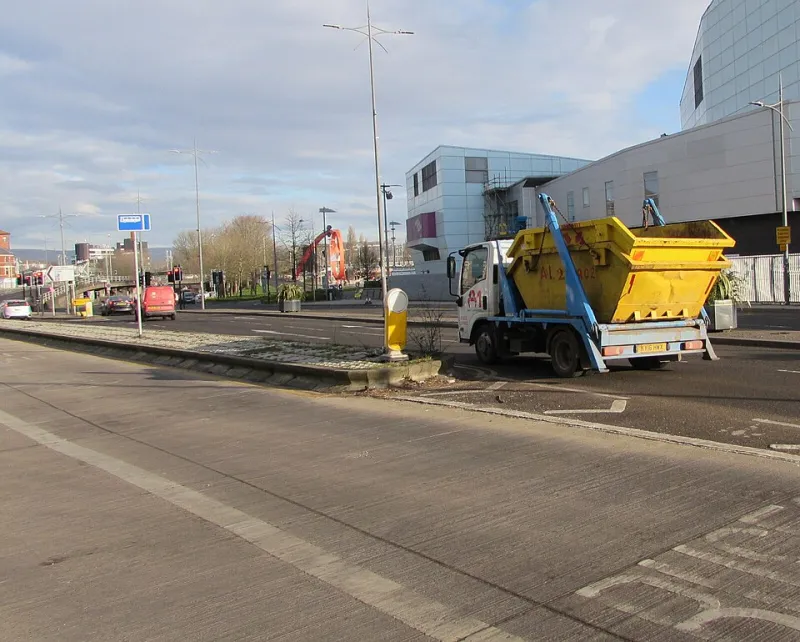
Photo: Jaggery , CC BY-SA 2.0, via Wikimedia Commons
The bit of fall you stop noticing
Stand at the bottom of most UK driveways and squint up towards the house. It looks flat enough. Then you put a spirit level on it, or watch a football roll gently towards the pavement, and the truth comes out: there’s a gradient. It might only be a few centimetres across four metres, but a skip lorry is a long, heavy vehicle with a tipping or sliding bed, and a loaded skip is an awkward lump of steel that wants to settle wherever gravity tells it.
A slope doesn’t automatically kill the job. Plenty of skips get dropped on gently falling ground every week. But the gradient changes what the driver can do, what you need to do before and after the drop, and how much risk sits with you if the skip shifts, the lorry can’t get level, or the driveway gives way under the legs. This is the practical version: check the slope, tell the firm the truth, and know when to choose a different plan.
What a gradient actually does to the delivery
Skip lorries don’t just reverse and tip. Depending on the firm and the vehicle, the skip may be slid off the back, craned into place, or lowered on a hydraulic arm. Each method wants a reasonably level patch of ground so the skip lands square rather than on one corner. A driver who can’t get the lorry stable, or who can see the skip will sit at an obvious angle, may refuse the drop — and that’s before anyone has loaded a single bag of rubble.
Even a modest slope affects three things:
- Footing. The skip’s skids or runners need to sit flat. On a slope, the weight concentrates on the downhill edge. That’s hard on block paving, tarmac and concrete, and it makes the skip more likely to creep.
- Loading. A skip that leans invites you to load it unevenly without realising. Heavy rubble dumped towards the low end puts extra strain on the sides and makes the whole thing less stable.
- Offload. A loaded skip is much heavier than an empty one. If it has settled into soft ground or shifted against a wall, the driver has a harder job getting it back onto the lorry.
The two-minute slope check
Before you book, do a quick survey. You don’t need surveying equipment — a phone level app and a tape measure will do.
- Find the steepest run. Measure the vertical drop over the longest straight stretch where the skip will sit. A 10 cm fall over 4 m is about a 2.5% gradient; 20 cm over 4 m is about 5%. Those numbers mean more to a hire firm than “it’s a bit slopy”.
- Check the cross-fall. A driveway can look level front-to-back but tilt sideways towards a drain or flower bed. That’s the angle that tips a skip onto one edge.
- Look at the surface. Block paving, fresh tarmac, gravel, grass and soil all behave differently. A slope on soft ground is a much bigger problem than the same slope on sound concrete.
- Photograph the drop point from the road. Include the gate, any walls, overhanging branches and the route the lorry will use. Drivers read photos faster than descriptions.
- Note the approach. Is there a kerb to mount? A narrow gate? Parked cars? A busy school run? The gradient is only half the access story.
What to tell the hire firm
Be specific, and don’t round the slope down to make the job sound easier. Say something like: “The skip will sit on block paving with roughly a 15 cm fall over 4 m, and there’s a cross-fall towards the drain. The lorry can reverse in, but the gate is 2.6 m wide.” Ask three questions:
- Will the driver need to use boards or packing to level the skip?
- Is the vehicle a slide-bed or a crane/HIAB lorry, and does that change what they need from you?
- If the driver decides the slope is unsafe, what’s the charge for a failed delivery?
That last one matters. A wasted trip isn’t free, and it’s better to hear the policy now than argue about it on the day.
On the day: packing, chocking and common sense
If the firm is happy to drop on a mild slope, expect to use scaffold boards or sturdy timber to create a level bearing surface. Don’t bodge it with loose bricks or offcuts that will crush and shift. Chock the downhill side if the driver asks, but never assume you should improvise unless they’ve told you to.
Keep the skip off grass, loose gravel and freshly laid tarmac, especially in warm weather. A loaded skip on a slope will find every soft spot. If the drive drains towards the house, think about where any water running off the skip will go; wet rubble is heavier and messier.
When loading, work in layers rather than heaping one end. Put heavy items low and spread them across the floor, then fill around them. Don’t use the sides as a retaining wall for a mountain of soil, and don’t overfill above the rim — an unstable skip is a false economy when the driver refuses to take it away.
When a different plan is better
If the slope is steep, the surface is soft, or the drop point sits above a retaining wall or drain, don’t push it. Consider:
- A flatter spot on the property. Even a few metres further back can change the angle enough.
- A permitted skip on the road. You’ll need a council permit and you’ll need to check parking restrictions, but level tarmac beats a tilted driveway.
- Wait-and-load. The skip stays on the lorry while you fill it. That suits short, intense clearances and avoids leaving a container on a gradient.
- A skip bag or hippo bag. These sit lower and are easier to place on awkward ground, though they still need a reasonably firm, level base and a collection lorry that can reach them.
A slope is not a dealbreaker, but it is a detail worth sorting before the lorry turns up. Measure the fall, photograph the drop, tell the firm the truth, and keep the heavy stuff low and spread out. That’s usually the difference between a clean drop and an expensive argument.